.svg)



.jpg)

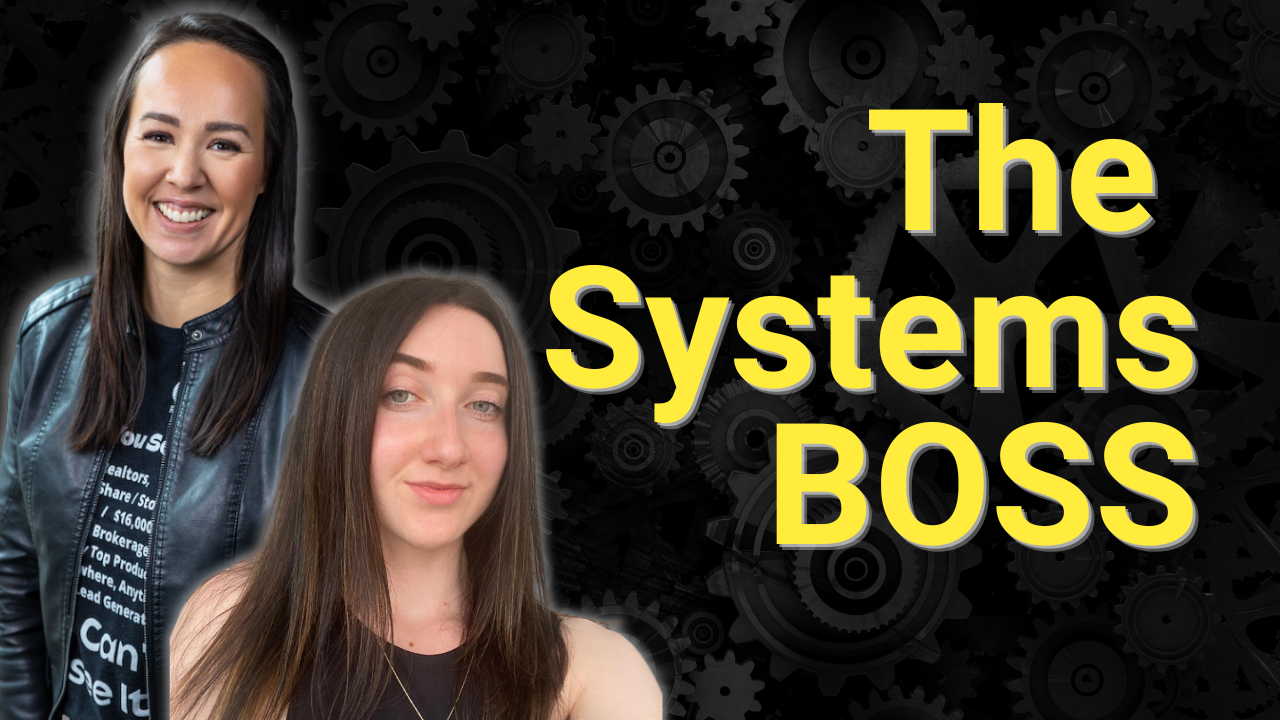

What's Actually Breaking Your Business (And the Systems Framework That Fixes It)
Date published:
May 20, 2026
There's a moment most business owners hit somewhere between the hustle and the growth — where you look around and realize that the systems you built aren't really working. The team isn't following the process. The SOPs are gathering dust. The tools are all there, but nothing is clicking together the way it should.
And the instinct is to go find a better tool. A new app. A faster fix.
Olivia Parkes, founder and CEO of The Systems Boss, has seen the inside of enough seven- and eight-figure businesses to know that the tool is almost never the problem.
I had the honor of sitting down with Olivia on The Systems Driven CEO podcast — and I say honor deliberately, because Olivia is someone I've worked with personally to build my own business. She knows operations at a level most people never get to see. And what she shared in this conversation is the kind of clarity that only comes from years of doing the deep work inside real companies.
The Business Nobody Told You You Were Building
Olivia didn't set out to be an operations expert. She was a pharmacology student in the UK who lost her father at 17 — a moment that cracked open her entire sense of what she was building her life toward. She started a marketing agency from her dorm room, cold-called non-alcoholic beverage companies off a spreadsheet she built herself, and eventually found her way to San Diego as a director of operations for a high-level sales coach.
That's where she got a look behind the curtain she couldn't unsee.
"I thought everybody had it together," she told me. "And then when I actually saw inside these businesses — companies that I'd known about for months before they became clients — everything was on fire."
Seven- and eight-figure revenue. Beautiful marketing. And backstage? Chaos.
What Olivia realized is that the people who look the most put-together from the outside often have the biggest operational gaps on the inside. Not because they're doing it wrong — but because they never had the time or the structure to actually build the backend. They were too busy growing to stop and systemize the growth.
That's who The Systems Boss exists to serve.
The Hole Most Businesses Don't Know They Have
When I asked Olivia what the most common gap she sees when a new client comes to her, she didn't hesitate.
It's not the wrong tool. It's not the wrong team. It's that nobody ever slowed down long enough to actually map the thing.
"What usually happens is people have a more complex process, but they just don't have the time to step away from the day to day, simplify it, actually map the workflow, build it, automate it, and maintain it."
So they build something on the fly. They make reasonable decisions under pressure. And the system that gets built holds up fine — until it doesn't. Until you hit a new hire, or a growth spike, or an edge case that nobody thought through because nobody ever sat down and thought it through.
The symptom looks like a people problem. Or a tool problem. But the root is almost always a process problem — specifically, a process that was never fully designed in the first place.
This is the deep work. And it's the work most people want to skip.
I see this exact pattern with the leaders I coach. They want the fix. They want to patch the leak. And what they actually need is to go back to the foundation and ask: what is this system actually supposed to do, and have we ever clearly defined that?
A System That No One Uses Is Not a System
Here's the other place it breaks — and Olivia was direct about this, because she's seen it enough times to know how predictable it is.
You do the work. You build the system. You have the big rollout moment. And then, slowly, quietly, nobody uses it.
"Once you create a system, it's not just thrown into the ether and hoping the team adopts it. There needs to be a clear process in place for the team to adopt it."
Adoption is its own project. It starts before the system goes live — with getting the team bought in on the specific pain points this system is going to solve for them. Not the pain points it solves for you. For them. Their day, their workflow, their friction.
Then it requires actual training. Not a screen share on Zoom. Getting team members to walk through the workflow themselves, in advance of launch, until it's already second nature before the system is even live.
And then it requires a deactivation of the old way. Not a gentle suggestion to stop using the spreadsheet. An actual switch-off, so the path back to the old habit doesn't exist anymore.
Even then, the leader still has to hold the standard. Every single time.
Your Business Becomes What You Tolerate
This is the line from our conversation that I keep coming back to.
Olivia said it simply: "Your business becomes what you tolerate. It doesn't become your highest aspirations."
I sat with that for a minute.
Because here's what I know to be true from my own experience — and from working with the leaders I coach: the things that are driving us crazy are not driving our team crazy. They're barely thinking about them. Because the only time something becomes real to a team member is when the leader names it, holds it, and follows through.
The leader who feels like she's going crazy noticing everything? She's the only one in the building carrying the weight of it. Her team saw it once and moved on. They're waiting — consciously or not — to find out whether this one actually matters. Whether it will be mentioned again. Whether there will be a consequence.
"Your team learns what you tolerate," Olivia said. "And if you don't bring it up again, they'll assume it wasn't that important."
The most successful leaders I know are the ones who stopped treating standard-setting as a one-time conversation and started treating it as a culture — something that gets reinforced every day, not announced once and abandoned.
The Context Gap — In Your Team and in Your AI
One of the most unexpectedly powerful threads in our conversation came when Olivia connected the way teams fail to the way AI fails — and it's the same problem.
Founders operate with a massive amount of assumed context. They know the origin story, the ICP, the offer inside-out, the brand voice, the non-negotiables. They've known it for so long that they've forgotten it needs to be taught.
So when a new hire comes in, they get the surface-level onboarding. The nice welcome. The tool logins. And then they're expected to operate with all the context the founder has spent years accumulating. It doesn't work. Not because the person isn't capable — but because they were never given what they needed to do the job.
AI operates exactly the same way.
"A big reason why people get mediocre results from AI is because they haven't given it enough context," Olivia explained. "The same reason employees fail at businesses."
The content automation workflows she builds for clients don't just prompt AI to write a post. They feed it a deep company bio, the ideal client profile, service outcomes, testimonials, founder origin story, reference content, and even proven marketing frameworks — all of it in the background before a single piece of content gets generated.
The idea is one sentence. The output is almost ready to publish.
That's not magic. That's context. The same context you need to give your team if you want them to operate without you in the room.
The Three Levels of AI Use
Olivia broke down AI adoption in a way that reframed how I think about where most people actually are with it.
Level one: you're going back and forth with ChatGPT. Prompting it on the fly. Getting okay results that don't really sound like you. This is where most people live.
Level two: you have structured, detailed prompts. You've put real thought into the inputs. The output is better.
Level three: you've built an automation. The context is pre-loaded. The trigger is a status change in your project management system. The output — a post, a blog, a lead enrichment summary — comes back nearly finished. You approve it. It schedules.
That's not a future-state thing. Olivia's clients are doing this now. And the key to it working is the same key that unlocks everything else we talked about in this episode: depth of context, clarity of standard, and a willingness to do the deep work on the front end so the system can carry the weight on the back end.
And here's what I'd add: humanness is your competitive advantage in all of it. The founders who will win with AI are the ones who give it the most specific, most personal, most distinctly them context to work from. The ones who voice their ideas, name their perspective, and let the automation do the formatting — not the thinking.
The Bottom Line
The conversation I had with Olivia Parkes is one of those that keeps working on you after the recording ends. Because what she's describing isn't a tech problem or a hiring problem or a systems problem — it's a standards problem. A leadership problem. An honesty-about-what-you've-been-building problem.
The businesses I see thrive are the ones where the leader is willing to do the deep work. To stop patching symptoms. To map the workflow, build the adoption plan, hold the standard, and show up every day as the person who takes responsibility for the culture they're creating — by design or by default.
Your business will become something. The question is whether you're choosing what it becomes.
Connect with Olivia Parkes and The Systems Boss:
Website: thesystemsboss.io
LinkedIn: Olivia Parkes
Ready to scale from sales to CEO? Book a strategy call with Lynea here.
.jpg)
.jpg)

.jpg)
%20(1).jpg)